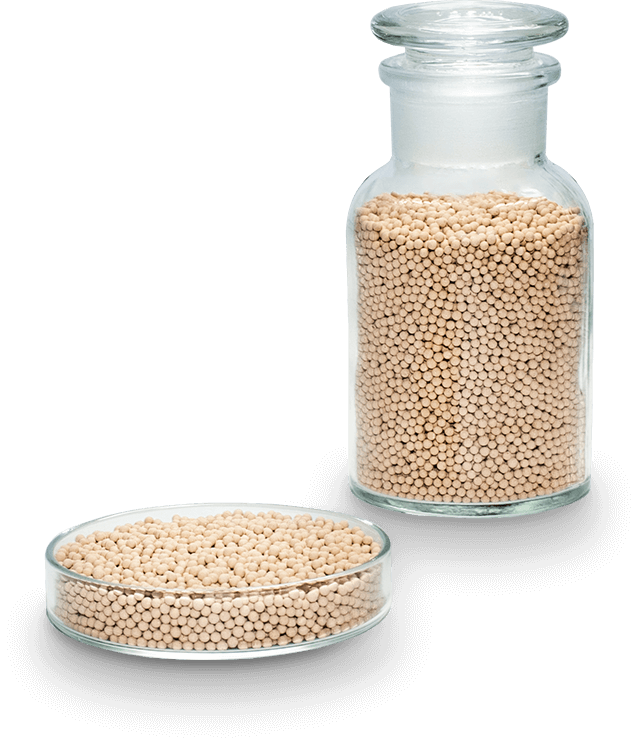
LiX and NaX Molecular Sieves for Oxygen Concentrator Service Applications

Technical adsorbent bed selection

LiX and NaX adsorbents selected according to PSA system type, particle size and required adsorbent bed volume.

Flexible packaging options

Packaging available from small service containers to 200 L drums, with options adapted to the customer’s logistics requirements.

Technical support

We help select the appropriate LiX or NaX adsorbent type according to the technical parameters of the unit and the service method.

Molecular Sieve Beds for Oxygen Concentrators

Molecular sieves are a key component of oxygen concentrators based on PSA or VPSA technology. Through selective adsorption of nitrogen from compressed air, they enable the production of a gas stream enriched with oxygen, in accordance with the operating parameters of a given unit.

In practice, two main types of molecular sieves are used: LiX, a lithium-exchanged X-type molecular sieve, and NaX, a sodium-exchanged X-type molecular sieve. These materials differ in nitrogen adsorption selectivity, separation efficiency and regeneration requirements. Proper selection of the molecular sieve type has a direct impact on process performance, operating stability and adsorbent bed lifetime.

Typical service-related applications include:

  • sieve bed replacements,
  • service cartridges,
  • compact adsorbent beds.

Regular replacement or regeneration of the adsorbent bed helps maintain stable operation of the concentrator, consistent separation performance and operating parameters in line with the equipment manufacturer’s requirements.

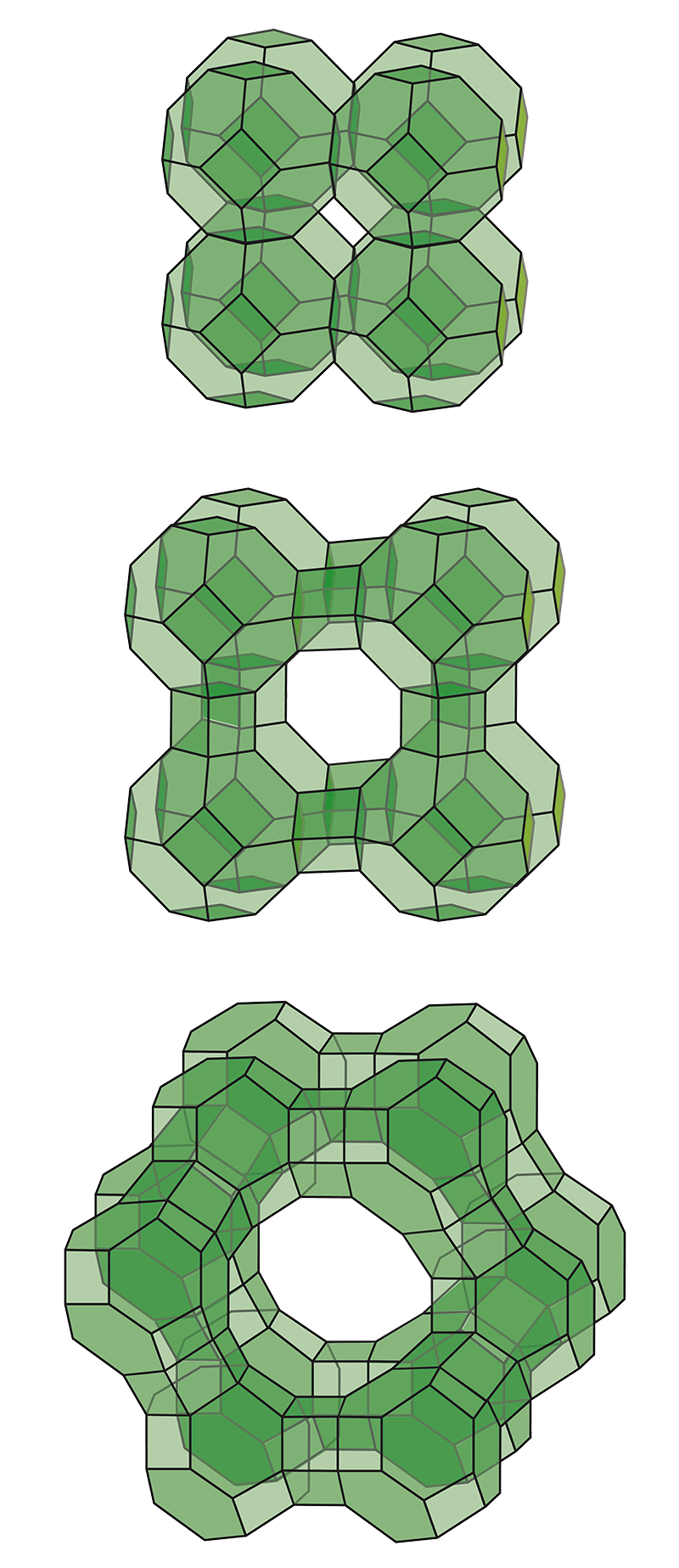
Schematic molecular sieve pore structures used to illustrate adsorbent framework types.

Oxygen concentrator systems are used to generate an oxygen-enriched gas stream from atmospheric air. Depending on the design, they may be configured as mobile technical units, compact service units or stationary systems with higher process capacity. A properly selected adsorbent bed is one of the key elements determining their operation.

The operation of oxygen concentrator systems is based on Pressure Swing Adsorption PSA or Vacuum Pressure Swing Adsorption VPSA technology. These processes rely on the cyclic separation of air components using molecular sieves, which are specialised syntetic adsorbents.

During the pressurisation phase, the molecular sieve selectively adsorbs nitrogen, allowing the remaining gas stream to become enriched with oxygen. During the depressurisation phase, the adsorbed nitrogen is desorbed and released from the system, and the operating cycle is repeated.

The process itself does not cause chemical consumption of the adsorbent. However, over time, adsorbent bed performance may deteriorate due to moisture, contaminants, dusting or operating conditions of the unit.

Two main types of molecular sieves are commonly used in oxygen concentrator systems:

Short comparison of LiX and NaX molecular sieves

LiX — lithium-exchanged X-type molecular sieve — offers higher nitrogen selectivity and higher adsorption capacity. It may support shorter PSA cycles, improved separation efficiency and reduced adsorbent bed volume in properly designed systems.

NaX — sodium-exchanged X-type molecular sieve — provides stable operation, wide availability and a more cost-effective purchase option. It is commonly used in lower-flow units, older system designs and applications where compatibility with the original adsorbent bed configuration is important.

The selection of the appropriate molecular sieve type depends on the concentrator design, required flow rate, adsorbent bed volume, particle size, operating cycle and equipment manufacturer’s recommendations.
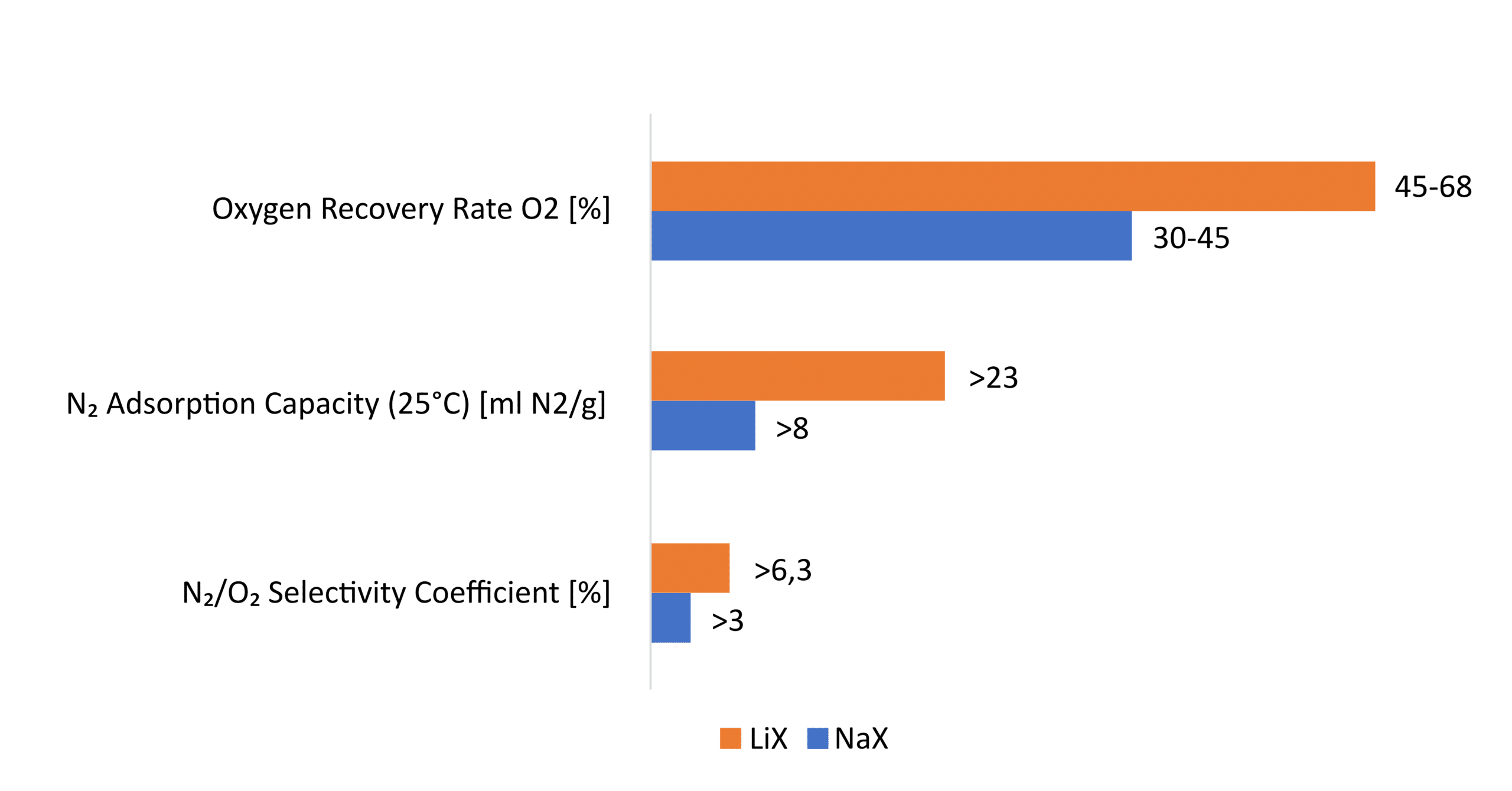
Molecular sieves used in oxygen concentrators differ in key adsorption properties, impacting the efficiency of the entire PSA/VPSA process. Below is a summary of the basic technical parameters of LiX and NaX sieves, including their selectivity for nitrogen, adsorption capacity, cycle time, and typical application areas. This aids in matching the sieve type to specific concentrator designs and user expectations.

Parameter NaX Molecular Sieves LiX Molecular Sieves
Physical Parameters
Form Spherical Spherical
Fraction Size 0.4-0.8 mm 0.4-0.8 mm
Bulk Density 660 kg/m³ 620 kg/m³
Typical application areas
Application Lower-flow units, older system designs, cost-effective operation Higher-flow units, compact PSA systems, higher separation efficiency
Typical O₂ flow rate 1-5 L/min 1-20 L/min
Adsorption Parameters
N₂/O₂ adsorption selectivity ≥3 ≥6.2
N₂ Adsorption Capacity at 25°C >8 ml/g >22 ml/g
Typical O₂ recovery in PSA system 30-45% 45-68%
Oxygen concentration in the product stream 93% ± 3% 93% ± 3%
Bar chart comparing LiX and NaX molecular sieves by O₂ recovery, N₂ adsorption capacity and N₂/O₂ selectivity.

The selection of the appropriate molecular sieve type is critical for stable PSA/VPSA system operation and for maintaining separation parameters in line with the technical requirements of the unit. In practice, two main types of molecular sieves are used in oxygen concentrator systems: NaX — sodium X-type molecular sieve — and LiX — lithium X-type molecular sieve.

Both materials are based on a similar crystalline structure, but they differ in adsorption properties, nitrogen selectivity and operating efficiency in PSA systems.

NaX – The Economical Solution

NaX molecular sieves are characterised by a favourable purchase cost, good operating stability and wide availability. They are mainly used in lower-flow oxygen concentrator systems, older system designs and units originally designed for sodium X-type sieve beds. Due to their lower nitrogen selectivity and lower adsorption capacity compared with LiX molecular sieves, the use of NaX may require a larger adsorbent bed volume or a longer PSA cycle time. This solution is suitable where cost-effective operation, material availability and compatibility with the original unit design are key priorities.

LiX – The High-Performance Adsorbent

LiX molecular sieves are characterised by high nitrogen selectivity and high adsorption capacity. In practice, this may allow the adsorbent bed volume to be reduced while maintaining the required operating parameters of the PSA system. As a result, LiX molecular sieves are particularly suitable for modern compact oxygen concentrator systems, higher-flow units and systems where high separation efficiency and reduced adsorbent bed weight are important. Due to their higher unit cost and greater requirements for system stability and operating precision, the selection of LiX molecular sieves should be consistent with the unit design and the manufacturer’s recommendations.

Selection Recommendations

The first step should always be to follow the recommendations of the equipment manufacturer and the original adsorbent bed specification. Units designed for a specific type of molecular sieve should not be operated with a material of different adsorption properties without prior technical verification.

For lower-flow units, older system designs and applications where cost-effective operation is important, NaX molecular sieve is often used.

For higher-flow concentrator systems, compact designs and applications with higher separation efficiency requirements, LiX molecular sieve may be the preferred option.

Contact us to select the appropriate molecular sieve type according to the technical parameters of the unit, adsorbent bed design and PSA system operating requirements.

We supply technical-grade LiX and NaX molecular sieves for companies servicing oxygen concentrator systems. These materials can be used for rebuilding or replacing adsorbent beds in selected models of stationary and mobile units. Molecular sieve selection should be based on the unit design, adsorbent bed type, required particle size, filling weight and manufacturer’s recommendations.

Stationary units — flow rate up to 5 L/min The selection of a LiX or NaX adsorbent bed depends on the adsorber design, filling weight, material particle size and PSA cycle parameters.
Stationary units — flow rate up to 10 L/min For higher flow rates, nitrogen adsorption selectivity, adsorbent bed volume, pressure drop and stable system operation are important factors.
Mobile units — pulse-flow operation In compact system designs, low adsorbent bed volume, low dust content and repeatable operation in short PSA cycles are particularly important.
Mobile units — continuous-flow operation Molecular sieve selection should take into account the required flow rate, column design, adsorbent bed regeneration method and equipment manufacturer’s recommendations.

The above categories are indicative only. Molecular sieve selection requires verification of the unit design, adsorbent bed type, adsorbent particle size, filling weight and manufacturer’s recommendations. The offered materials are not OEM products.
Why Our Sieves?

  • Technical selection: matching particle size, filling weight and adsorbent type to the unit design.
  • Stable operation: high N₂ adsorption selectivity and repeatable performance in PSA cycles.
  • Material protection: low dust content, controlled initial moisture content and sealed packaging.

The offered molecular sieves and materials for adsorbent bed rebuilding are not OEM products. Their selection requires verification of the technical parameters of the specific unit, adsorbent bed design, adsorbent particle size and filling weight.

Precise adsorbent bed selection for PSA systems

We supply LiX and NaX molecular sieves for companies servicing oxygen concentrator systems. We help select the appropriate adsorbent type, particle size and material quantity according to the technical parameters of the unit, adsorbent bed design and PSA system operating requirements.

Ask about molecular sieve selection

Industrial 200 L drums for LiX and NaX molecular sieve supply.