Container desiccant bags ES Clay

ES Clay container desiccant bags contain natural clay with calcium chloride, which absorbs water vapour from the air around the cargo. Each 1000 g bag has a hook for quick installation on the container wall. ES Clay is designed for transit times of up to 30 days.

Request a quote

ES Clay 1000 g container desiccant bag with a plastic hook

ES Clay technical data, dosage and downloads

Product data, typical quantities, installation and documents.

Description

ES Clay container desiccant bags

ES Clay container desiccant bags are hanging bags for use inside shipping containers on sea and land routes. The filling is a granulate of natural clay with high-purity calcium chloride. It absorbs water vapour from the air in the container, lowers the relative humidity and helps prevent condensation on the cargo. The absorbed water is retained inside the bag.

Typical cargo includes agricultural products, machinery, textiles, PVC paste and other packaged goods. ES Clay is designed for transit times of up to 30 days, counted from loading to unloading, including waiting time in ports. Typical quantities are given in the Dosage tab.

Longer routes. For transit times over 30 days, choose ES K (up to 60 days) or ES Gel container desiccant strips.

Technical data

ES Clay container desiccant bag with natural clay granulate

ES Clay 1000 g technical data

  • Composition: natural clay and high-purity calcium chloride (CaCl₂, CAS 10043-52-4)
  • Bag: 1000 g nonwoven bag with a plastic hook, 250 × 200 × 20 mm
  • Water absorption capacity at 25 °C and 95% RH: up to 60% of its own weight
  • Dust tightness: the nonwoven bag meets the dust-tightness requirements for type A desiccant bags under DIN 55473
  • Service life: trips of up to 30 days
  • Packing: airtight plastic bag, 16 bags per transport carton (16 kg), carton 315 × 300 × 280 mm
  • Shelf life: 24 months in unopened packaging, stored in a dry room at 5-30 °C
  • HS code: 2508 40 00
  • Compliance: REACH (free from dimethyl fumarate, Annex XVII, entry 61) and RoHS (Directive 2011/65/EU)

Dosage

How many ES Clay bags does a container need?

Typical quantities for a transit time of up to 30 days, counted from loading to unloading, including waiting time in ports:

Container Low-moisture cargo [bags] Moisture-releasing cargo [bags]
20′ 20 32
40′ and 40′ HC 40 64

Low-moisture cargo: metal, machinery, plastics, electronics, furniture and products made of dry wood.

Moisture-releasing cargo: food and agricultural commodities such as grain, flour, coffee, cocoa, sugar and nuts, raw or fresh wood, and goods with a history of mould.

For low-moisture cargo, the typical quantity also covers goods on wooden pallets, in crates or in cartons. For moisture-releasing cargo, use up to 37 bags in a 20′ container and up to 74 in a 40′ container for routes through the tropics or across the equator, the rainy or monsoon season, containers carried on deck, loading in rain and a wet container floor.

Transit times over 30 days: ES Clay is not recommended. Choose ES K or ES Gel; send us the route and cargo details and we will propose the number of units.

Installation in the container

Hang the bags by their hooks in the upper part of both side walls and near the doors, spaced evenly along the container. Keep them at least 25 mm from the cargo so they cannot be crushed during loading, and leave space for air to circulate around each bag. Do not place the bags on the container floor. Open the collective bag just before installation, because contact with air before installation reduces the capacity of the bags.

Moisture in containers

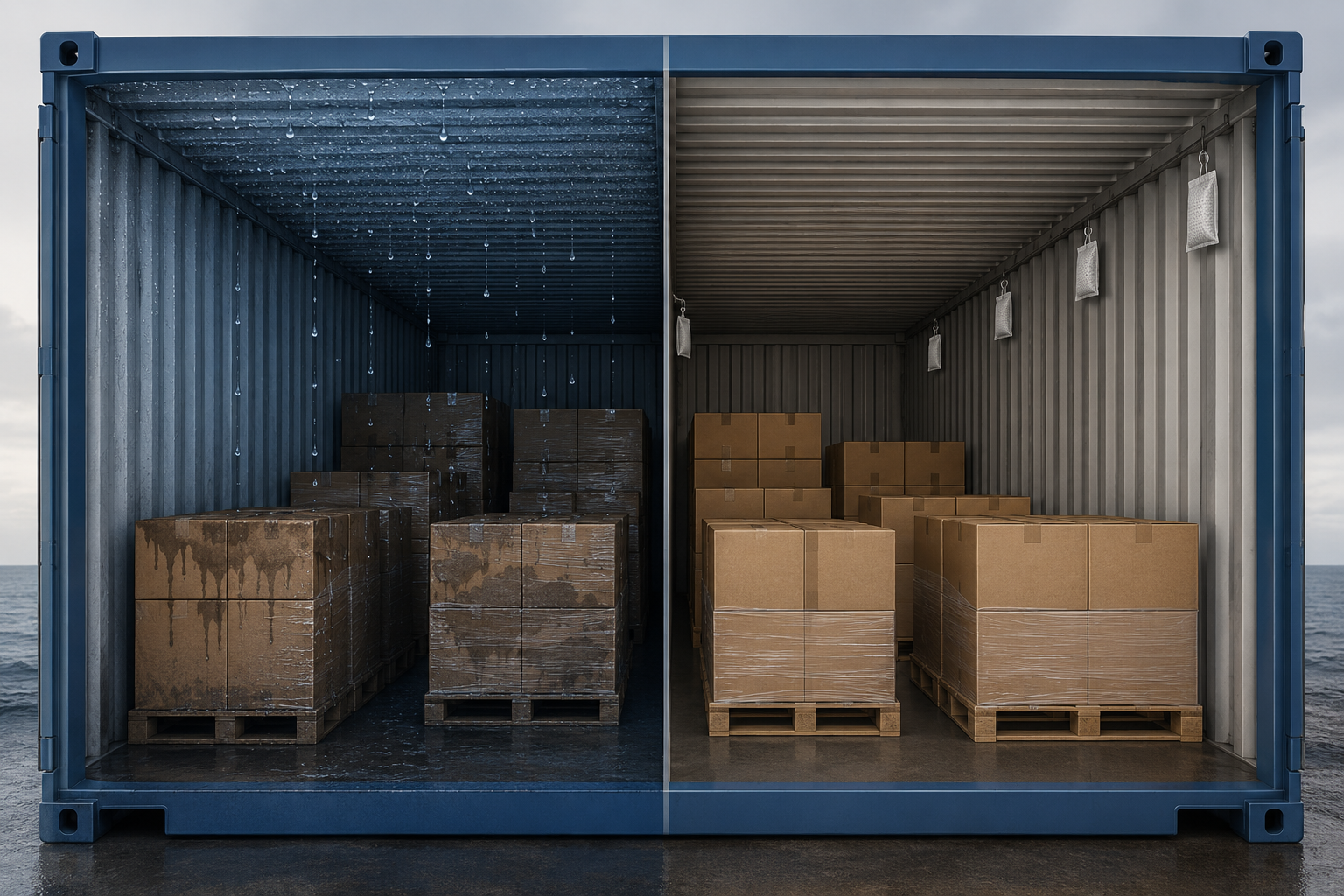
Illustration comparing container rain and wet cargo on the left with dry cargo and hanging desiccant bags on the right

Moisture in shipping containers and container rain

Moisture inside a shipping container may come from the air, pallets, packaging and the cargo itself. When the container walls and ceiling become cooler than the air inside, water vapour condenses on them. Droplets may then fall onto the cargo. This is known as container rain, and it can cause wet cartons, corrosion of metal parts and mould. ES Clay bags absorb water vapour from the air in the container and help reduce this risk.

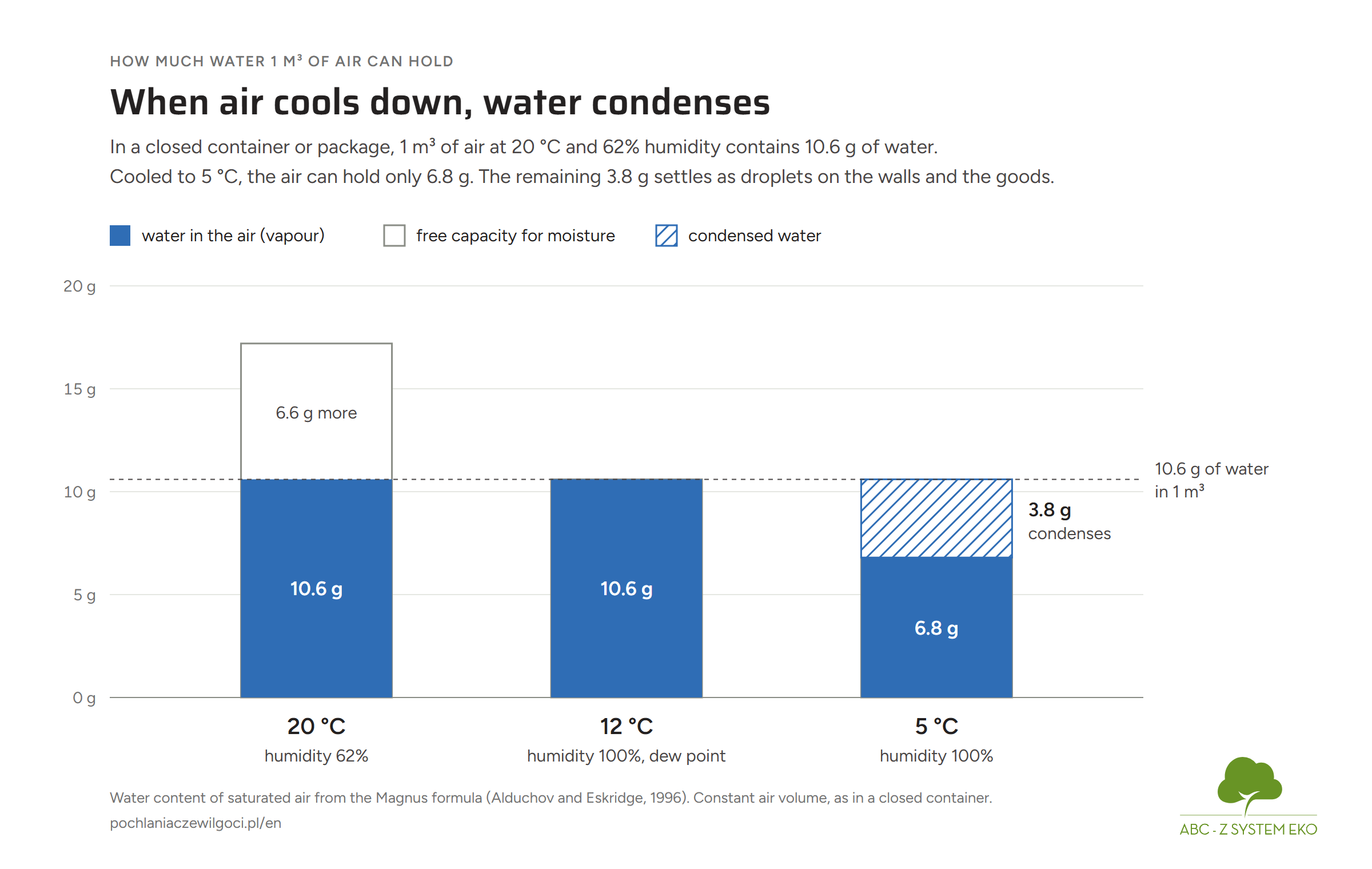
When the air inside a closed container cools, part of its water vapour condenses on the walls, the ceiling and the cargo, as the chart below shows.

Condensation chart for a fixed air volume of 1 m³: 10.6 g of water vapour at 20 °C and about 62% relative humidity, saturation at about 12 °C, and 3.8 g condensed after cooling to 5 °C, leaving 6.8 g as vapour

Files to download

Safety Data Sheet (SDS) on request. Send us a message using the form below or write to us, and we will send the current document.

Need to protect container cargo on routes of up to 30 days?

We supply ES Clay 1000 g container desiccant bags with a mounting hook for sea and land transport. The bags are packed 16 per transport carton (315 × 300 × 280 mm). Larger orders are shipped on pallets. Minimum order: one carton. Most orders are dispatched within 2-5 working days. Delivery time is confirmed in the quotation. To speed up the quotation, send the number of bags or cartons, the container size, cargo and transit time, and the delivery country and date.

Request a quote

ES container desiccant bags with plastic hooks and a sample of granular filling

Clay desiccant bags: technical and ordering questions

  • Yes. Place the bags inside the moisture barrier, for example a sealed barrier bag or hood, not outside it. Share the pallet dimensions, the barrier type and the storage period, and we will suggest the number of bags.

  • Store the bags in the closed collective bag, in a dry room at 5-30 °C. The shelf life in unopened packaging is 24 months. Open the collective bag just before installation in the container and keep any unused bags in an airtight container.

Request a quote for ES Clay container desiccant bags

Tell us the container size, cargo and transit time, and we will propose the number of bags and send a quotation.