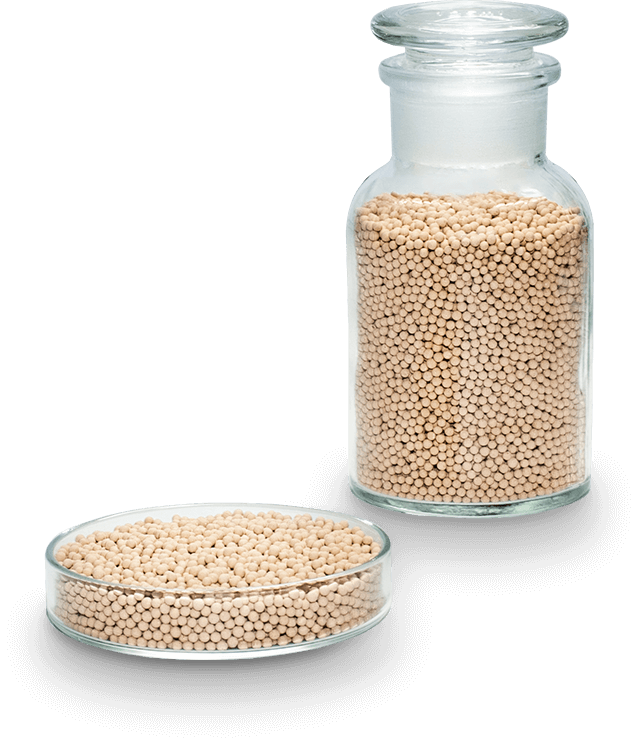
13X zeolite molecular sieve for gas drying and air pre-purification
We are a European B2B supplier of 13X zeolite molecular sieve for industrial dryers, air pre-purification units and PSA oxygen plants. We supply it as loose beads: 13X removes water and CO₂ in one bed, and it also removes H₂S and mercaptans from natural gas and LPG.
Available as original Grace SYLOBEAD 13X, Honeywell UOP MOLSIV 13X and Jalon 13X and JLPM3 grades, and as equivalents of these and of BASF and Arkema Siliporite grades. Most orders are dispatched within 2-5 working days.
Molecular sieve 13X is the sodium form of type X zeolite, with the faujasite (FAU) structure and a nominal pore opening of about 8-10 Å, depending on the grade. Its pores are larger than those of type A sieves, so besides water it takes up CO₂, H₂S, mercaptans and other larger molecules. Pore size is not an absolute cut-off: adsorption also depends on polarity, stream composition and operating conditions. Its high capacity for both water and CO₂ lets one bed remove both from a gas stream.
Molecular sieve 13X
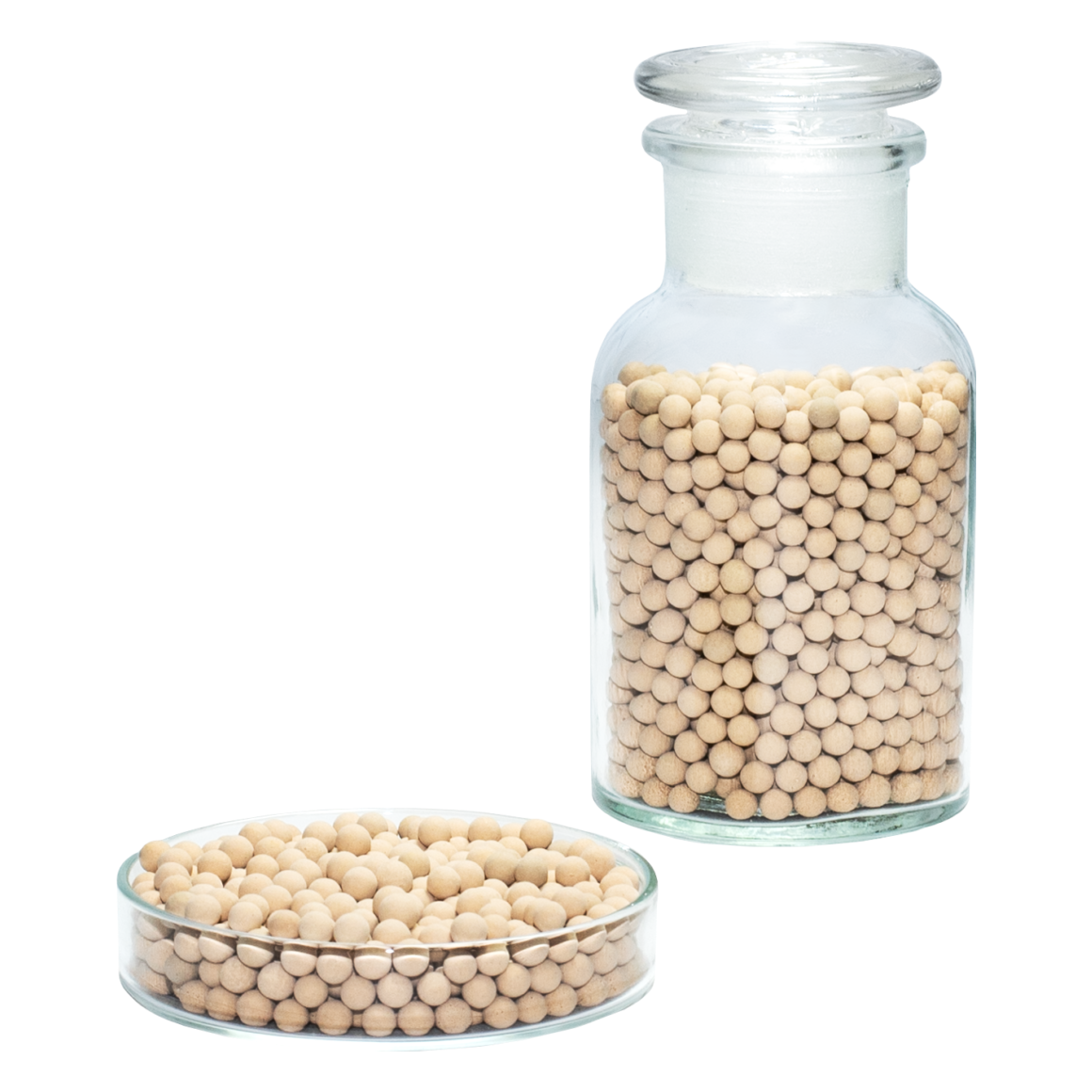
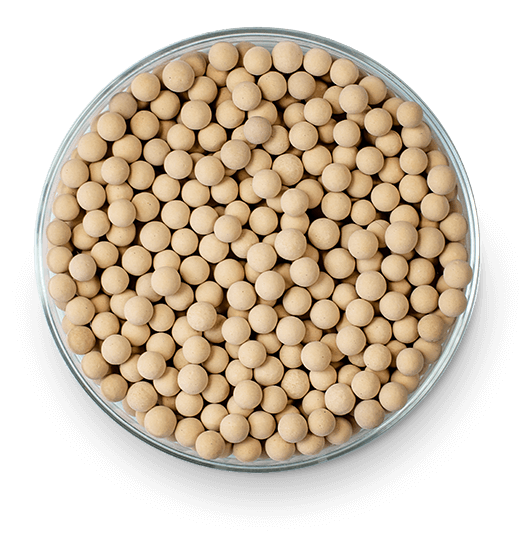
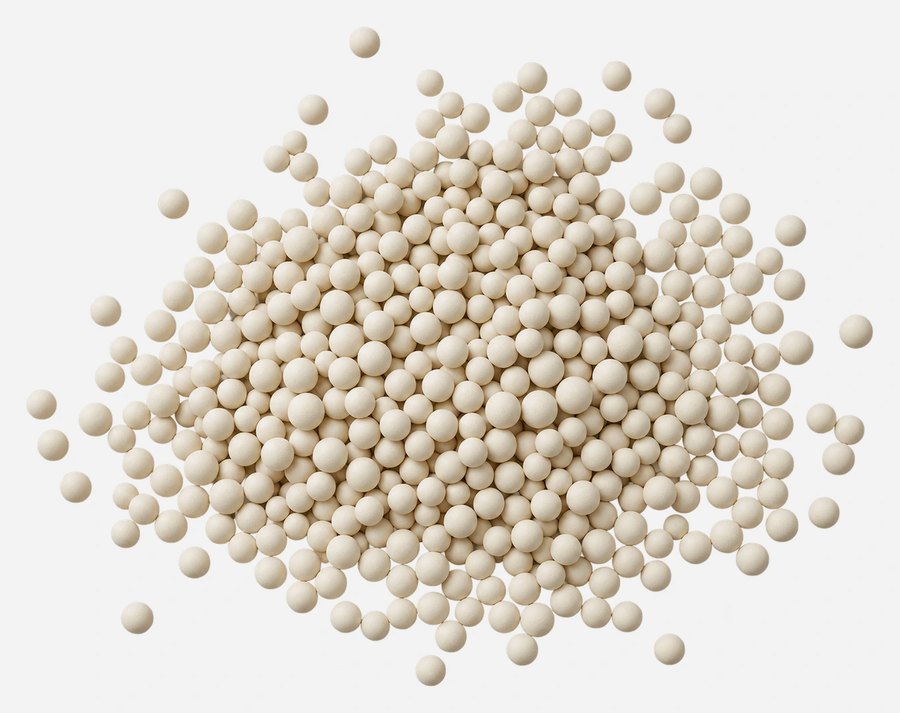
The standard clay-bound 13X grade. It is used for air pre-purification before cryogenic air separation, for drying gases and liquids, and for removing H₂S and mercaptans from natural gas and LPG. Bead sizes: 1.6-2.5 mm and 2.5-5 mm, and 4×8 mesh and 8×12 mesh.
Binderless molecular sieve 13X
Zeolite 13X without an inert binder: nearly all of the bead mass is active zeolite, with an open system of transport pores. This gives faster mass transfer and a higher CO₂ capacity than clay-bound 13X: min. 30.0 cm³(STP)/g against min. 24.0 cm³(STP)/g at 25 °C and 2.4 mbar. It is used where fast adsorption cycles or a high capacity are needed, including PSA and VPSA units. Bead size: 1.6-2.5 mm.
Molecular sieve 13X for oxygen production
A clay-bound 13X grade specified by its nitrogen capacity, for PSA and VPSA plants that produce oxygen from air without cryogenics: min. 7.4 cm³(STP)/g of nitrogen at 25 °C and 1000 mbar. Bead size: 1.6-2.5 mm.
The first table compares the three types of 13X we supply: their zeolite form, pore opening, bead sizes and main use. The second table lists each grade with its data from the technical data sheet: bead size, bulk density, crush strength and the adsorption of water and CO₂. “min.” is a specification minimum; “typical” is a typical value, not a specification. Confirm the specification of the supplied grade before ordering.
Air pre-purification, gas drying, natural gas and LPG sweetening
Fast cycles and high capacity, PSA and VPSA
Nitrogen adsorption in PSA and VPSA oxygen plants
Data by grade
Grade
Bead size
Bulk density [kg/m³]
Crush strength [N]
Water adsorption [% w/w]
CO₂ adsorption
Molecular sieve 13X
1.6-2.5 mm
655-700
min. 25
min. 26.5 (20 °C, 55% RH)
min. 24.0 cm³(STP)/g (25 °C, 2.4 mbar)
Molecular sieve 13X
2.5-5 mm
655-700
min. 50
min. 26.5 (20 °C, 55% RH)
min. 24.0 cm³(STP)/g (25 °C, 2.4 mbar)
SYLOBEAD 13X MS-544
1.6-2.5 mm
675, typical
40, typical
23.0 (25 °C, 10% RH) and 29.0 (25 °C, 80% RH), typical
5.0% w/w (25 °C, 2 torr) and 19.0% w/w (25 °C, 250 torr), typical
UOP MOLSIV 13X
4×8 mesh (2.38-4.76 mm)
641, typical
80, typical
26 (25 °C, water vapour pressure 2.33 kPa), typical
not stated
UOP MOLSIV 13X
8×12 mesh (1.41-2.38 mm)
641, typical
36, typical
26 (25 °C, water vapour pressure 2.33 kPa), typical
not stated
Binderless molecular sieve 13X
1.6-2.5 mm
620-700
min. 25
not stated
min. 30.0 cm³(STP)/g (25 °C, 2.4 mbar)
Molecular sieve 13X for oxygen production*
1.6-2.5 mm
655-700
min. 25
not stated
not stated
Additional information: the data sheets measure bulk density in different ways (after compaction, without compaction or by sock loading), so compare density values together with their test conditions.
* Molecular sieve 13X for oxygen production is used in PSA and VPSA plants, where the bed separates nitrogen from oxygen. Its data sheet therefore gives the nitrogen capacity instead of water and CO₂ adsorption: min. 7.4 cm³(STP)/g at 25 °C and 1000 mbar, and min. 2.4 cm³(STP)/g at 300 mbar, measured on an activated sample.
Applications
Applications of 13X molecular sieve
Air pre-purification before cryogenic air separation
Water and CO₂ freeze at cryogenic temperatures and would block the heat exchangers of an air separation plant. The pre-purifier removes both from the compressed feed air, and 13X takes up both in one bed.
Natural gas and LPG sweetening
13X removes H₂S, mercaptans and other sulphur compounds from natural gas and LPG, and can dry the stream at the same time.
Drying of gases and liquids
13X dries process gases, compressed air and liquids, especially where CO₂ must be removed together with water.
Plastic granulate dryers
In hopper dryers for plastic granulate, 13X dries the air and also takes up by-products released from the polymer, such as acetaldehyde and ethylene glycol.
PSA and VPSA oxygen plants
In non-cryogenic oxygen plants, the bed adsorbs nitrogen from compressed air and lets oxygen through. Use the grade for oxygen production or binderless 13X, chosen for the cycle of the plant.
Hydrogen PSA
In hydrogen PSA units, 13X removes CO₂, and 5A takes up nitrogen and carbon monoxide.
How pore size influences the application
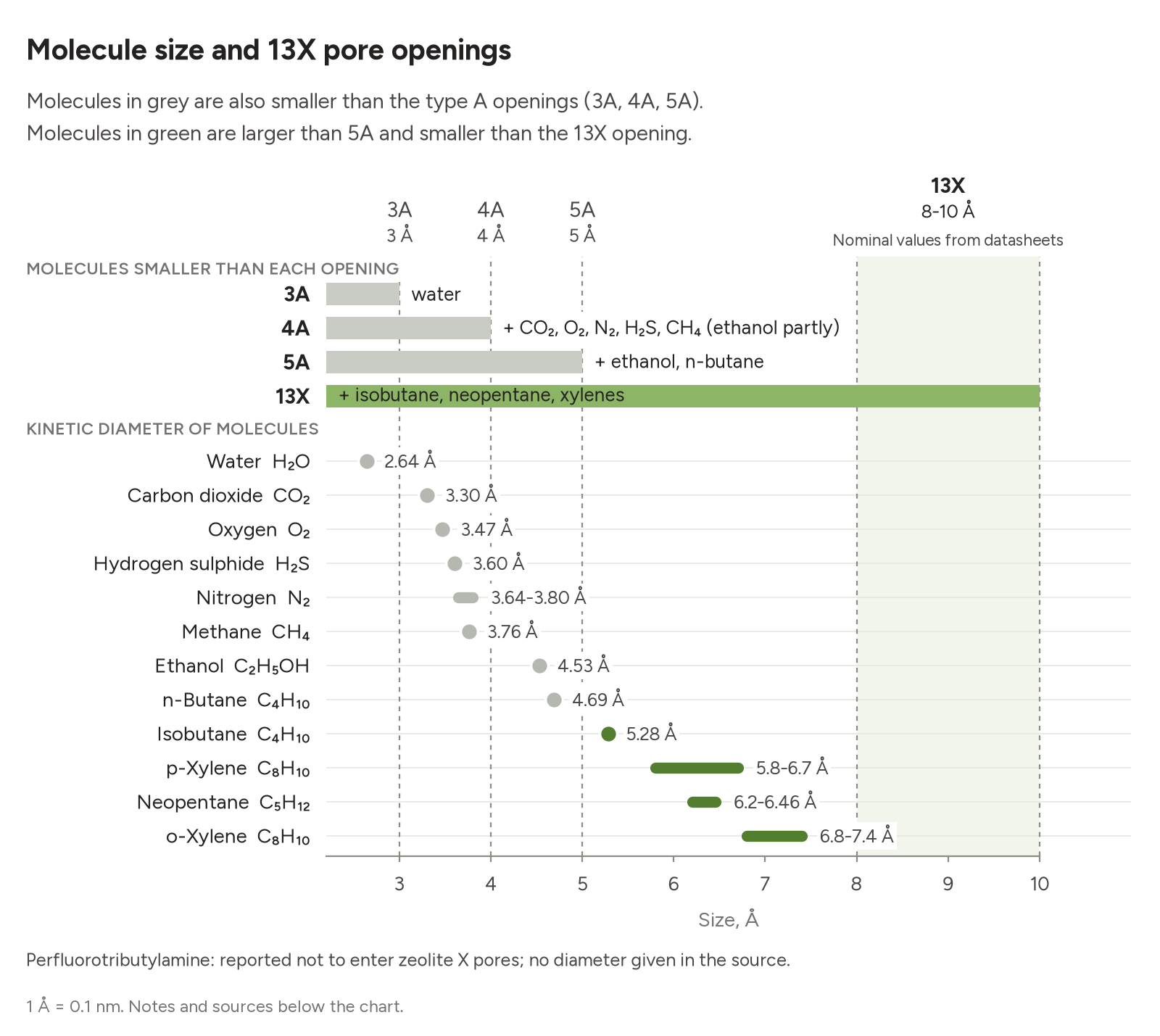
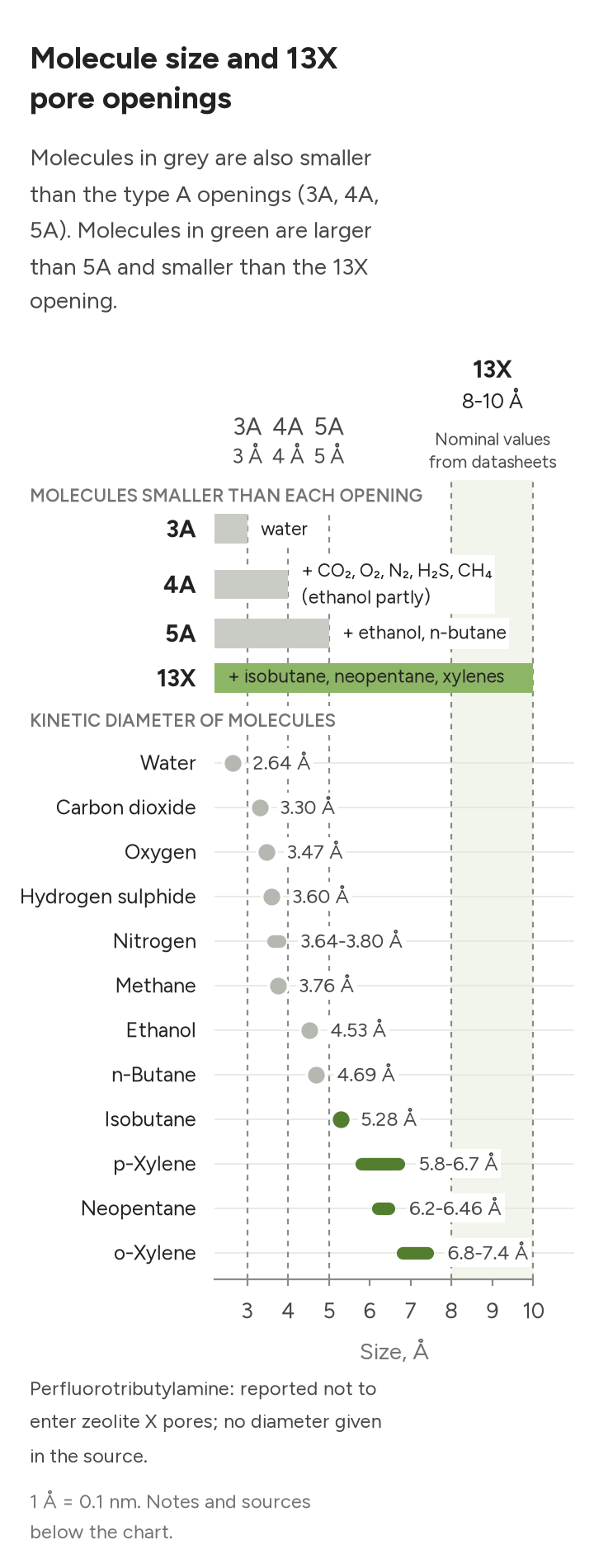
Grey and green: molecules in grey are also smaller than the type A openings; molecules in green are larger than 5A and smaller than the nominal 13X opening. Nominal pore openings are a guide, not a strict size limit, and the 13X values shown come from different manufacturer datasheets. The chart compares sizes; it does not predict adsorption capacity or selectivity. Dots show single reported values; lines show reported ranges or values from different sources. Perfluorotributylamine is reported not to enter zeolite X pores, and the same source reports a small uptake of 2.2% by weight at 23 °C; it gives no diameter for the molecule. Sources: kinetic diameters from Pérez-Botella E., Valencia S. and Rey F., Chemical Reviews 2022, 122, 17647, Table 2; H₂S from Pérez-Pellitero J. and Pirngruber G. D., Structure and Bonding 2020, Fig. 2; ethanol on LTA zeolites from Chaibi A., Boucheffa Y. and Bendjaballah-Lalaoui N., Microporous and Mesoporous Materials 2021, 324, 111285; perfluorotributylamine from Milton R. M., US patent 2,882,244 (1959). Nominal pore openings from manufacturers’ datasheets (13X: 8, 9 and about 10 Å).
Pore opening and co-adsorption
13X has the largest pores of the zeolite molecular sieves compared here (3A, 4A, 5A and 13X). It takes up water, CO₂, H₂S and mercaptans, but it also admits many larger molecules from the stream. Where only water must be removed and the product must not be co-adsorbed, a type A sieve with a smaller opening, such as 3A, is usually the better choice. Check which components of your stream could be co-adsorbed before you choose the type.
Regeneration
13X is regenerated by raising the temperature, by reducing the pressure or by purging with a suitable gas. The regeneration mode depends on the application and is usually part of the process design. It must take into account the limited resistance of the sieve to thermal and hydrothermal stress.
Before filling the adsorber
Contact with humid air reduces the capacity of the sieve before it is even in the adsorber. Keep the beads in their sealed packaging until filling, and fill the vessel in a dry place. Active 13X releases heat when it adsorbs water, so avoid contact of large quantities with water or wet air during handling.
Molecular sieve 13X, spherical, 1.6-2.5 mm and 2.5-5 mm. CAS 1318-02-1.
Binderless molecular sieve 13X, spherical, 1.6-2.5 mm.
Molecular sieve 13X for oxygen production, spherical, 1.6-2.5 mm.
Original products: SYLOBEAD 13X MS-544 in 1.6-2.5 mm from Grace, and UOP MOLSIV 13X in 4×8 mesh and 8×12 mesh from Honeywell UOP, and Jalon 13X and JLPM3.
Equivalents:
13X: an equivalent of 13X grades such as BASF 13X Molecular Sieve, Arkema Siliporite G5, Grace SYLOBEAD MS-542 and Honeywell UOP MOLSIV 13X APG;
binderless 13X: an equivalent of binderless 13X grades such as BASF 13XBF;
13X for oxygen production: an equivalent of 13X grades for oxygen PSA such as Honeywell UOP MOLSIV PSAO2 XP.
Send the brand and exact grade you use now so that we can compare the data sheets, particle sizes and process requirements. An equivalent is not a guarantee of identical performance. TDS and SDS are available on request.
Product names such as SYLOBEAD, MOLSIV, JLPM and Siliporite belong to their respective owners and are used for reference only.
13X molecular sieve is packed in airtight steel drums of 125-135 kg net and in big bags of 450-800 kg with a PE liner laminated with aluminium foil. Other packaging is available on request.
Most orders are dispatched within 2-5 working days. The price depends on the grade, quantity and packaging and is given in the quotation.
Replacing the bed in a dryer or pre-purifier?
For a quotation and the technical data sheet, please send us:
the gas or liquid and the components to remove;
the type and bead size used now, or its datasheet;
the fill mass or vessel volume and the quantity you need.
Frequently asked questions about 13X molecular sieve
4A has a pore opening of about 4 Å and is the general drying grade for gases and liquids. 13X has a larger opening of about 8-10 Å, depending on the grade, and a high capacity for both water and CO₂. It is used for air pre-purification before cryogenic air separation and for removing H₂S and mercaptans from natural gas and LPG. Choose 4A when water is the main component to remove, and 13X when CO₂ or sulphur compounds must be removed as well.
Non-cryogenic PSA and VPSA oxygen plants use 13X selected for its nitrogen capacity. We supply a clay-bound 13X for oxygen production, with min. 7.4 cm³(STP)/g of nitrogen at 25 °C and 1000 mbar, and binderless 13X for fast cycles. Send the plant type, the bead size and the grade used now, so that we can compare them.
The name 13X HP is used for sieve beds in oxygen concentrators, but it does not identify a material specification. For this application, see LiX and NaX molecular sieves for oxygen concentrators, where you can send the datasheet or a photo of the label of the material used now.
By raising the temperature, by reducing the pressure or by purging with a suitable gas. The conditions depend on the process and are usually set in the equipment design. Send your current regeneration method and conditions with your enquiry, and we will check them against the data sheet of the grade.
Clay-bound 13X adsorbs min. 26.5% of its weight in water at 20 °C and 55% RH, and min. 24.0 cm³(STP)/g of CO₂ at 25 °C and 2.4 mbar. Binderless 13X adsorbs min. 30.0 cm³(STP)/g of CO₂ under the same conditions. These are laboratory values for an activated sample; the working capacity in your adsorber depends on the temperature, pressure, cycle and regeneration. The values for each grade are in the Types and data tab.
Store it in airtight packaging in a dry room until use, so that it does not adsorb moisture from the surroundings. Close opened packaging carefully to protect the beads against water, other vapours and contamination. For SYLOBEAD 13X MS-544, Grace recommends use within 4 years in drums and within 6 months in big bags from the date of production.
Request a quote for 13X molecular sieve
Send the gas or liquid, the components to remove, the type and bead size used now and the quantity you need. We will reply with a quotation and the technical data sheet.