Industrial zeolite molecular sieves for gas and liquid drying

We are a European B2B supplier of industrial molecular sieves for drying gases and liquids, removing CO₂ and sulphur compounds, air pre-purification and PSA gas separation. Molecular sieve beads of types 3A, 4A, 5A and 13X are available in sizes such as 1.6-2.5 mm, 2.5-5 mm and 3-5 mm.

We supply original SYLOBEAD, UOP MOLSIV, Zeochem ZEOX and Jalon molecular sieves. We also offer equivalent grades, including equivalents of SILIPORITE and BASF products. Most adsorbents are dispatched within 2-5 working days.

Request a quote

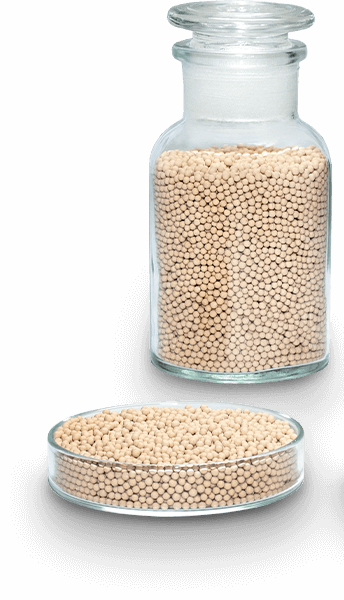
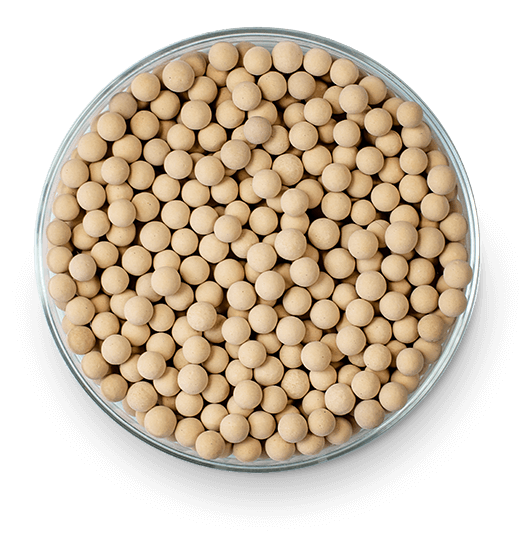
Close-up of molecular sieve beads in glass jars and dishes.

Which molecular sieve for which application

Type Nominal pore opening What it adsorbs Typical applications
3A 3 Å Water; ethanol and most other molecules are too large to enter the pores Selective drying of alcohols, olefins and natural gas
3A for insulating glass 3 Å Water; nitrogen and oxygen stay outside the pores Filling spacer bars of insulating glass units
4A 4 Å Water and CO₂ Drying of gases, liquids and air in adsorption dryers
5A, binderless 5 Å Molecules up to about 5 Å, including nitrogen PSA and VSA gas separation
13X 8-10 Å, depending on the grade Water and CO₂ together, H₂S and mercaptans Air pre-purification, gas purification and industrial oxygen generation
LiX and NaX 10 Å for NaX; not given for LiX Nitrogen from air Oxygen concentrators
Carbon molecular sieve About 3-5 Å (literature value) Oxygen faster than nitrogen PSA nitrogen generators
Close-up of molecular sieve beads in glass jars and dishes.

Type A and type X zeolite molecular sieves

Zeolite molecular sieves are synthetic adsorbents with a uniform pore structure, used for selective adsorption of water and other molecules from gases and liquids. We supply LTA molecular sieves 3A, 4A and 5A, and 13X molecular sieves, as original products and equivalent grades. For oxygen concentrators, we supply LiX and NaX beads: the original JLOX-101A and ZEOX OII grades and equivalent grades.

3A molecular sieve beads used for gas and air drying

Molecular sieves 3A, 4A and 5A (LTA)

Type A (LTA) zeolites with nominal pore openings of 3, 4 and 5 Å. 3A dries alcohols and olefins without co-adsorbing them, 4A is used for general drying of gases, liquids and air, and binderless 5A for PSA and VSA gas separation.

3A, 4A and 5A molecular sieves

13X molecular sieve beads for gas drying and purification

13X molecular sieve

Type X zeolite with a pore opening of 8-10 Å, depending on the grade. Used to remove water and CO₂ together, for air pre-purification before cryogenic air separation, for desulphurisation of natural gas and LPG, and in industrial PSA oxygen generators.

13X molecular sieve

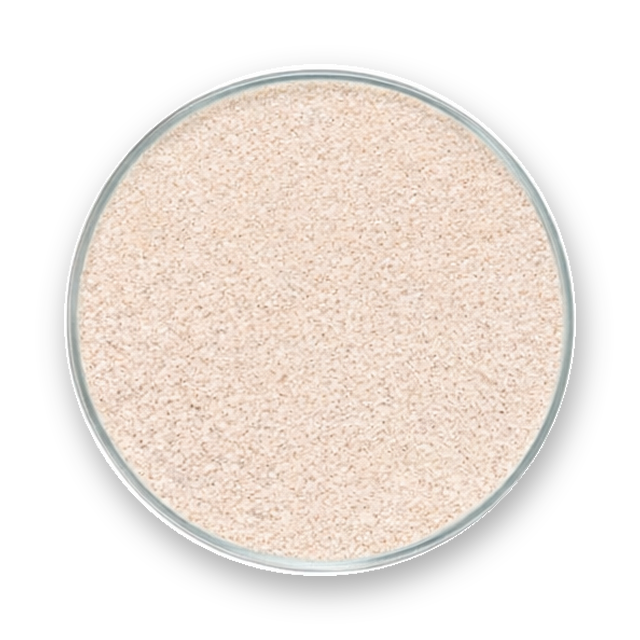
LiX and NaX molecular sieve beads, 0.4-0.8 mm, in a glass dish.

LiX and NaX molecular sieves

Lithium and sodium type X grades in 0.4-0.8 mm beads that adsorb nitrogen from air in oxygen concentrators. Supplied as loose material for replacing the sieve fill, in 2 kg tins and in drums. Other packaging is available on request.

LiX and NaX molecular sieves

Pore openings and molecule sizes

The chart compares the nominal pore openings of 3A, 4A, 5A and 13X with the kinetic diameters of common molecules. Pore opening is a useful guide to which molecules can enter, but the boundary is not sharp for molecules close to the nominal opening.

Molecule size and pore openings

Compare molecule sizes with nominal pore openings; size alone does not show how much a sieve adsorbs. Choose a sieve type with the buttons below. Molecules smaller than its nominal opening turn green; the hatched area is larger than the pore opening. Point at a molecule, or tap it, for a note.

Of the molecules in this chart, only water is smaller than the 3A opening. Ethanol and the other molecules in this chart are too large, so 3A dries alcohols, olefins and natural gas without co-adsorbing them. 3A molecular sieves
CO₂, O₂, N₂, H₂S and methane are also smaller than the 4A opening; ethanol is partly co-adsorbed. It is used for drying gases, liquids and air in adsorption dryers. 4A molecular sieves
Ethanol and n-butane are also smaller than the 5A opening; branched isobutane is larger. Binderless 5A is used for PSA and VSA gas separation. 5A molecular sieves
All molecules in this chart except perfluorotributylamine are smaller than the nominal 13X opening, including isobutane, neopentane and xylenes. It removes water and CO₂ together and is used for air pre-purification, desulphurisation and industrial oxygen generation. 13X molecular sieve
enters the porespartly co-adsorbeddoes not enterlarger than the pore opening
3A3 Å 4A4 Å 5A5 Å 13X8-10 Å
Pore openings of 3A, 4A, 5A and 13X
What each type admits
3Awater
4A+ CO₂, O₂, N₂, H₂S, CH₄ (ethanol partly)
5A+ ethanol, n-butane
13X+ isobutane, neopentane, xylenes
Kinetic diameter of molecules
Area larger than the pore opening
Water H₂O
2.64 Å
Kinetic diameter 2.64 Å. Water enters all four types; this is why 3A can remove it while keeping larger molecules out.
Carbon dioxide CO₂
3.30 Å
Kinetic diameter 3.30 Å. Too large for 3A; enters 4A, 5A and 13X.
Oxygen O₂
3.47 Å
Kinetic diameter 3.47 Å. Enters 4A, 5A and 13X.
Hydrogen sulphide H₂S
3.60 Å
Kinetic diameter 3.60 Å, from Pérez-Pellitero and Pirngruber (2020); the other diameters are from Pérez-Botella et al. (2022).
Nitrogen N₂
3.64-3.80 Å
The source gives a range of 3.64-3.80 Å. Nitrogen enters 4A, 5A and 13X.
Methane CH₄
3.76 Å
Kinetic diameter 3.76 Å. Enters 4A, 5A and 13X.
Ethanol C₂H₅OH
4.53 Å
Ethanol (4.53 Å) is larger than the nominal 4A opening, yet it is partly co-adsorbed on 4A and 5A. The sodium ions in the 4A pore windows can move aside for polar molecules such as ethanol, and thermal vibration makes the effective opening larger. This is why 3A is used to dry ethanol.
n-Butane C₄H₁₀
4.69 Å
Kinetic diameter 4.69 Å. This linear molecule enters 5A and 13X, but not 4A.
Isobutane C₄H₁₀
5.28 Å
Kinetic diameter 5.28 Å. The branched isomer of butane is too large for 5A and enters 13X.
p-Xylene C₈H₁₀
5.8-6.7 Å
The source gives two values from different references, 5.8 and 6.7 Å. Enters 13X only.
Neopentane C₅H₁₂
6.2-6.46 Å
Kinetic diameter 6.2-6.46 Å. Enters 13X only.
o-Xylene C₈H₁₀
6.8-7.4 Å
Two values from different references, 6.8 and 7.4 Å. Faujasite zeolites such as 13X are the adsorbents of choice for separating xylenes.
Perfluorotributylamine (C₄F₉)₃N
no diameter reported
The 1959 patent on zeolite X reports that zeolite X does not permit entry of this molecule, with a small uptake of 2.2% by weight at 23 °C. The source gives no kinetic diameter, so the chart shows no point.
3456 78910 Size, Å

A molecule can enter the pores when it is smaller than the pore opening; near the opening the limit is not sharp. The 13X pore opening is 8-10 Å, depending on the grade.

Sources: kinetic diameters from Pérez-Botella E., Valencia S. and Rey F., Chemical Reviews 2022, 122, 17647, Table 2; H₂S from Pérez-Pellitero J. and Pirngruber G. D., Structure and Bonding 2020, Fig. 2; ethanol on LTA zeolites from Chaibi A., Boucheffa Y. and Bendjaballah-Lalaoui N., Microporous and Mesoporous Materials 2021, 324, 111285; ion gating and thermal vibration from Chen K. et al., Chemical Society Reviews 2022, 51, 1139; perfluorotributylamine from Milton R. M., US patent 2,882,244 (1959). Nominal pore openings from manufacturers’ datasheets.

Description

Zeolite molecular sieves for drying and purification

Zeolite molecular sieves are synthetic crystalline aluminosilicates. Their crystal structure contains cavities connected by pore openings of uniform size, which control which molecules can enter. Adsorption also depends on the molecule, on the zeolite and on the operating conditions. Zeolite molecular sieve desiccants are used for deep drying of gases and liquids; the residual moisture achieved depends on the grade, the process conditions and the regeneration cycle.

Types 3A, 4A and 5A share the type A zeolite structure. In 3A, some sodium ions are replaced by potassium ions; 4A is the sodium form; and 5A is a calcium-exchanged form. Their nominal pore openings are 3, 4 and 5 Å, respectively. Type 13X has the type X structure and a pore opening of 8-10 Å, depending on the grade. LiX and NaX are type X grades for oxygen concentrators and are described on a separate page.

Our range includes zeolite beads with a binder and binderless beads. Binderless 5A and 13X grades are used in processes that need fast mass transfer and high capacity, such as PSA and VSA units. The grade is selected according to type, bead size, mechanical strength, adsorption capacity under the process conditions and the regeneration method.

Applications

Molecular sieve for gas drying

Molecular sieves are used for drying natural gas, cracked gas, olefins such as ethylene and propylene, LPG, inert gases and air. 3A is used where the dried gas must not be co-adsorbed, for example easily polymerising unsaturated hydrocarbons. 4A and 13X are used where water and CO₂ are removed together.

Drying of liquids and solvents

3A is used to dry polar liquids such as ethanol and methanol, because the sieve takes up water without co-adsorbing the dried liquid. 4A is used to dry liquid hydrocarbons, solvents and refrigerants.

Compressed air and plastic granulate dryers

4A and 13X molecular sieves are used in adsorption dryers for compressed air and in dryers for plastic granulate. A pressure dew point of -70 °C can be reached in heatless and heat-regenerated compressed air dryers when the bed contains 4A molecular sieve; the result depends on the dryer design, the regeneration cycle and the operating conditions.

Air pre-purification before cryogenic air separation

In air separation units, 13X molecular sieve removes water and CO₂ from air before the cold box, often downstream of an activated alumina layer. Removing water and CO₂ helps prevent ice and dry ice from forming in the cryogenic section.

Gas purification: CO₂ and sulphur compounds

13X molecular sieve removes CO₂ from air and gases, and H₂S, mercaptans and other sulphur compounds from natural gas and LPG. Datasheets give the CO₂ capacity at a stated partial pressure and temperature, so grades are compared under the same conditions.

PSA and VSA gas separation

Binderless 5A is used in PSA and VSA units that need fast mass transfer. 13X grades for oxygen production are used in industrial PSA and VPSA oxygen generators. LiX and NaX are used in oxygen concentrators.

Carbon molecular sieve for nitrogen generators

Carbon molecular sieve is a carbon adsorbent, not a zeolite. In PSA nitrogen generators it adsorbs oxygen from compressed air faster than nitrogen, so nitrogen leaves the column as the product gas. We supply carbon molecular sieve as cylindrical pellets with a nominal diameter of 1.3 mm, 1.5 mm or 1.8 mm, depending on the grade. Nitrogen productivity and recovery depend on the grade and on the test conditions stated in its datasheet, so we compare grades on their datasheets against the requirements of your generator.

Originals and equivalents

Grades we supply

  • 3A molecular sieve: beads of 1.6-2.5 mm and 2.5-5 mm, and fine beads of 0.5-0.9 mm and 1.0-1.5 mm for insulating glass.
  • 4A molecular sieve: beads of 1.6-2.5 mm, 2.5-5 mm and 3-5 mm.
  • Binderless 5A molecular sieve: beads of 1.6-2.5 mm.
  • 13X molecular sieve: beads of 1.6-2.5 mm, 2.5-5 mm; binderless 13X of 1.6-2.5 mm; 13X grades for oxygen production.
  • LiX and NaX molecular sieves for oxygen concentrators: beads of 0.4-0.8 mm.
  • Carbon molecular sieve: pellets of 1.3 mm, 1.5 mm or 1.8 mm for PSA nitrogen generators (see Applications).

Original products

We supply original SYLOBEAD molecular sieves from Grace (3A MS-564C, 4A MS-514 and MS-512, 13X MS-544), UOP MOLSIV 4A and 13X from Honeywell UOP, ZEOX OII from Zeochem, and Jalon 4A, 13X, JLPM3 and JLOX-101A.

Equivalents

We also supply equivalents of SYLOBEAD (Grace), MOLSIV (Honeywell UOP), SILIPORITE (CECA, Arkema), Zeochem and BASF molecular sieves. We select a possible equivalent by sieve type, bead size and process requirements, and we send its technical data sheet so that you can compare it with your current specification. Tell us the brand and grade you use now, and we will propose an equivalent for comparison. For SILIPORITE and BASF grades we supply equivalents only; the original products we supply are listed above. For oxygen concentrators, we supply the original JLOX-101A and ZEOX OII grades and equivalent LiX and NaX grades, and we compare datasheets of other brands with them. This comparison does not confirm compatibility with a particular device.

Product names such as SYLOBEAD, MOLSIV, SILIPORITE, ZEOX, JLOX and JLPM belong to their respective owners and are used for reference only.

Packaging and delivery

Pallet with sealed steel drums of SYLOBEAD molecular sieves prepared for industrial B2B delivery from a European adsorbent distributor.

Packaging

Molecular sieves are supplied as loose beads or pellets. Depending on the grade, they are packed in sealed 5-litre plastic canisters, 25 kg plastic drums, airtight steel drums of 125-150 kg net and big bags. LiX and NaX for oxygen concentrators are also supplied in 2 kg tins.

Ordering and delivery

Most adsorbents are dispatched within 2-5 working days. TDS and SDS are available on request.

Replacing the bed in your dryer or adsorber?

Send us the details below. We will propose a suitable grade and send its technical data sheet, so that you can compare it with the product you use now.

  • equipment type, and the fill mass or vessel dimensions
  • bead size and the product used now
  • operating conditions: gas, pressure, temperature and the required dew point

Request a quote

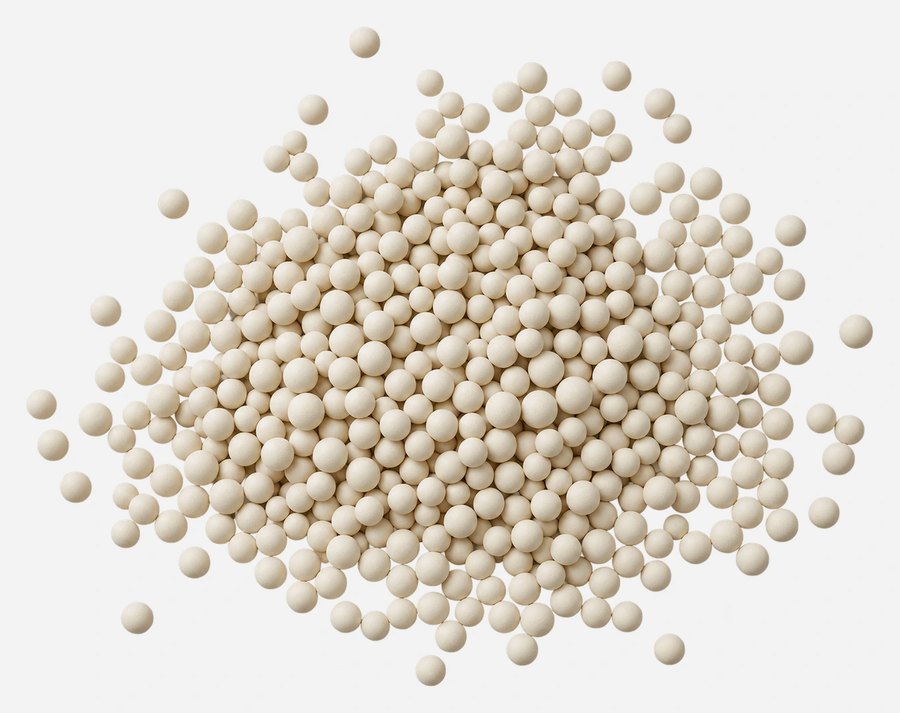
Zeolite molecular sieve beads.

Frequently asked questions about molecular sieves

  • A molecular sieve is a porous adsorbent that separates molecules according to their access to its pores and their adsorption behaviour. Our range includes zeolite molecular sieves for drying, purification and gas separation, and carbon molecular sieve for PSA nitrogen generators.

  • Zeolite molecular sieves such as 3A, 4A, 5A and 13X are synthetic zeolites, and in industry the two names are often used for the same material. Carbon molecular sieve is a carbon adsorbent, not a zeolite. It separates gases by the different rate at which they are adsorbed and is used mainly in PSA nitrogen generators.

  • Start with the components to be removed and those that must remain in the stream, then check the operating conditions and the regeneration method. The selection table at the top of this page shows a suitable type, and the type tiles below it lead to the available grades. For a replacement bed, also send the specification of the product used now, the requirements of the equipment and the process parameters of the installation.

  • We supply molecular sieve as an adsorbent material, in beads or pellets, for filling dryers, adsorbers and refillable cartridges. We do not supply finished filters or cartridges. For a replacement fill, send the equipment type, the fill mass or vessel dimensions, the bead size and the product used now.

  • Water adsorption capacity is given in percent by mass at a stated temperature and relative humidity, either as a minimum or as a typical value. Values measured under different conditions cannot be compared directly. For SYLOBEAD 3A MS-564C, for example, Grace gives a typical capacity of 17.5% at 10% relative humidity and 21.5% at 80% relative humidity, both at 25 °C. Our datasheet for 3A molecular sieve, 1.6-2.5 mm, gives min. 21.0% at 20 °C and 55% relative humidity. Working capacity is the amount adsorbed and released during the operating cycle. It depends on regeneration, temperature and other adsorbed components, so it cannot be read directly from a single equilibrium value in a datasheet.

  • Depending on the grade and the process, molecular sieves are regenerated by heating, by reducing the pressure or by purging with a suitable gas. The regeneration method and conditions must match the adsorbent and the equipment, and are usually part of the process design. For our 3A molecular sieve, 1.6-2.5 mm, the technical data sheet recommends regenerating the bed with dry process gas before the first process cycle. For other grades, confirm the start-up and regeneration procedure with the equipment instructions and the product documentation.

  • Before use, molecular sieves should be stored in airtight containers in a dry room, so that they do not adsorb moisture from the surroundings. Opened packaging should be closed carefully to protect the product against contamination, water and other vapours. Storage recommendations depend on the grade and packaging. For SYLOBEAD 3A MS-564C and 4A MS-514, Grace recommends using material from big bags within 6 months and from drums within 4 years.

  • Packaging options are listed in the Packaging and delivery tab above. For a quotation, send the medium and its composition, the component to be removed and the required outlet specification. Include the flow rate, pressure, temperature and regeneration method. State the required quantity or vessel volume and the product used now. The price depends on the grade, quantity and packaging and is given in the quotation.

Request a quote for molecular sieves

Send the medium, the component to be removed, the process conditions and the product used now, and we will propose a grade and prepare a quotation.