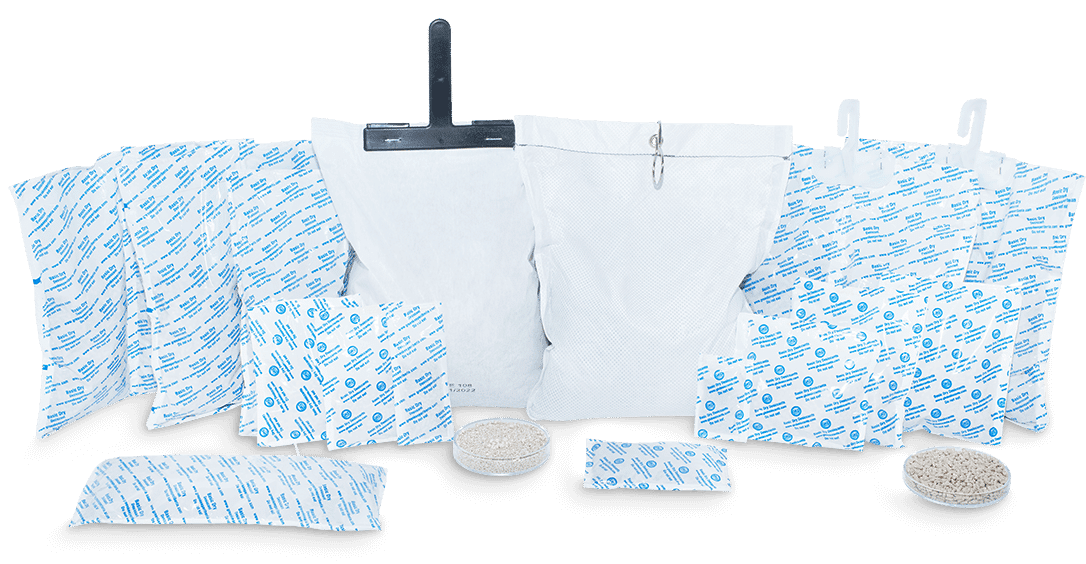
 Adsorption
 Desiccants for compressed air dryers: silica gel, activated alumina or molecular sieve
The desiccant for a compressed air dryer is selected according to the required dew point and the way the dryer regenerates its bed. The capacity stated in the technical data sheet does not decide the choice on its own, because the material that binds the most water from humid air does not necessarily give the driest air at the dryer outlet.
In brief
- The dew point of compressed air is always given together with the pressure at which it was measured. The same value measured in the system and after expansion to atmospheric pressure describes air with a different water content.
- The driest air is obtained in dryers with a molecular sieve bed. Activated alumina and silica gel are used where less dry air is sufficient.
- The desiccant must match the way the dryer regenerates its bed. Molecular sieve requires a higher regeneration temperature than silica gel and activated alumina.
- The amount of desiccant in a dryer is specified in the documentation of the dryer manufacturer. It is not calculated from the capacity given in the desiccant data sheet.
Pressure dew point and compressed air purity classes
The dew point is the temperature at which the water vapour contained in a gas begins to condense. For compressed air, it is given at the operating pressure as the pressure dew point, abbreviated as PDP in dryer data sheets. Compression does not change the amount of water in the air, but it raises the partial pressure of water vapour in proportion to the total pressure, so the same amount of vapour condenses at a higher temperature [5]. Below 0 °C, water vapour deposits as ice, and the correct name for this temperature is the frost point [4]. In the compressed air industry, however, both quantities are called the dew point.
The ISO 8573-1:2010 standard defines compressed air purity classes separately for solid particles, for humidity and liquid water, and for oil. The purity classes for humidity and liquid water (water classes) 1 to 6 are defined by the pressure dew point, and classes 7 to 9 by the liquid water content [1] [2]. We also discuss the pressure dew point and the purity classes in the article Adsorption drying of compressed air.
| Water class according to ISO 8573-1 | Pressure dew point | Examples of applications |
|---|---|---|
| 1 | not higher than -70 °C | semiconductors, pharmaceuticals, gases for analytical instruments |
| 2 | not higher than -40 °C | food industry, chemical industry, paint shops, systems exposed to frost |
| 3 | not higher than -20 °C | process air in heated buildings |
| 4 | not higher than +3 °C | refrigerant dryers, general workshop use |
The applications in the table are examples, not a requirement of the standard. The required class is specified by the user of the system or by the manufacturer of the equipment supplied with the air. A refrigerant dryer reaches class 4 at best, because at a lower temperature the condensate would freeze in the heat exchanger [2]. For classes 1 to 3, adsorption dryers are used in practice.
Converting the dew point to atmospheric pressure
The dew point must always be given together with the pressure at which it was measured. The same air has a dew point of -40 °C in a system at 7 bar(g), and about -57 °C after expansion to atmospheric pressure [3]. If a data sheet or a measurement result gives -40 °C without a pressure, and this value refers to atmospheric pressure, the pressure dew point in a system at 7 bar(g) is only about -20 °C. This corresponds to water class 3 instead of the required class 2.
Send us the dryer model, the regeneration type, the operating pressure and the required pressure dew point, and we will indicate which materials can be considered.
Desiccants for compressed air drying: comparison of three groups
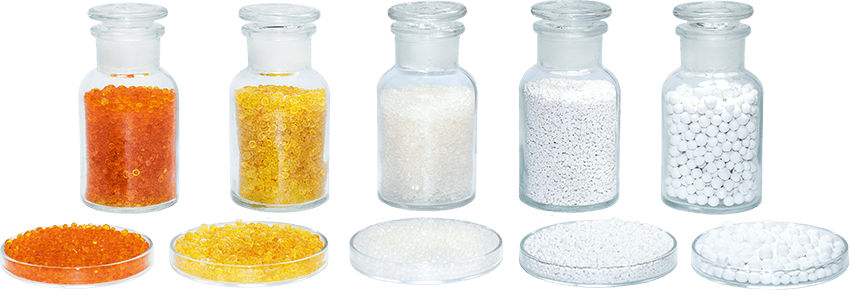
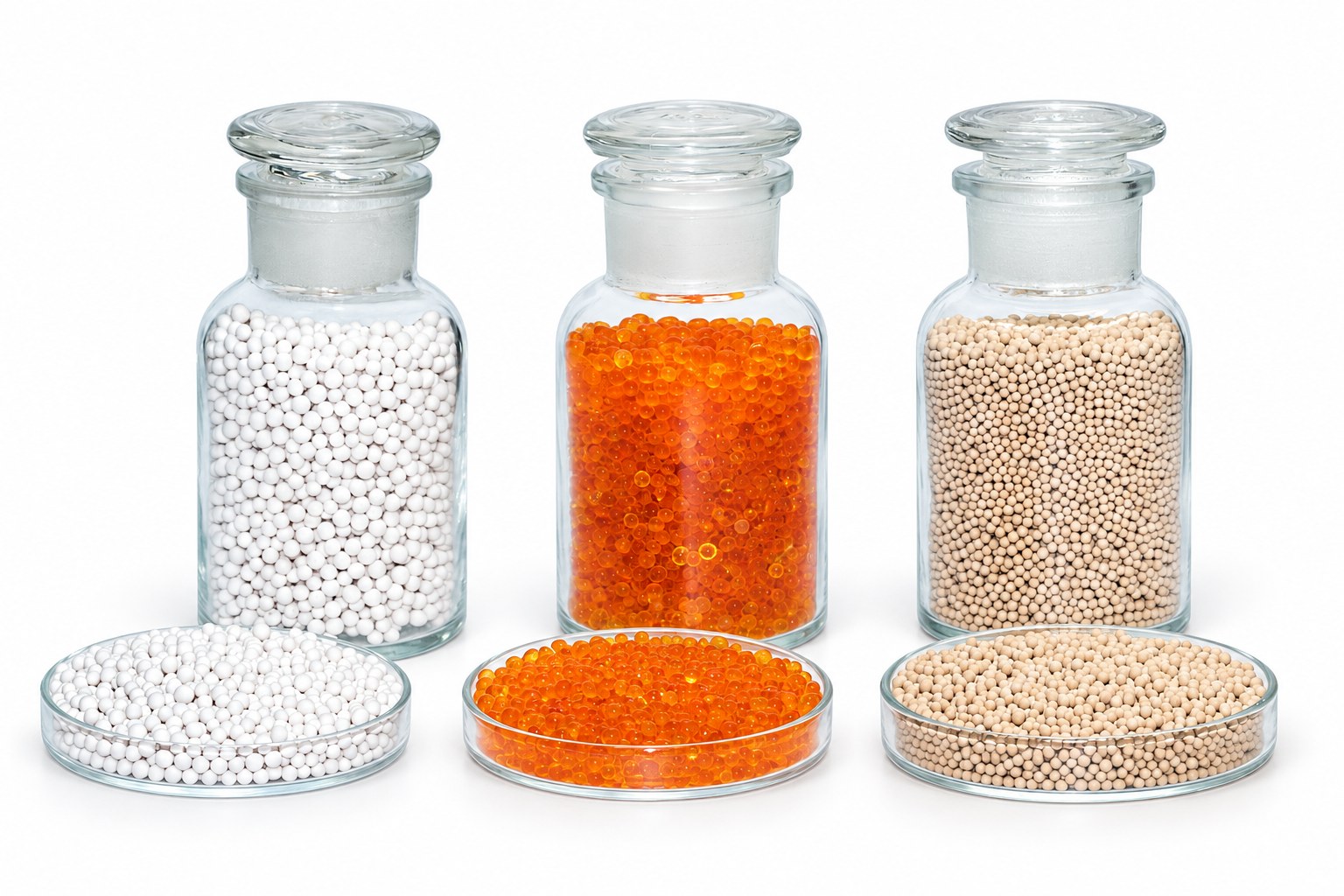
Compressed air is dried with silica gels, activated alumina and zeolite molecular sieves. A comparison of these materials is only meaningful when the values were measured under the same conditions. For this reason, the table below is based on a single overview from one manufacturer that offers all three groups.
| Material | Equilibrium capacity for water vapour at 25 °C and 80% relative humidity | Resistance to liquid water | Lowest pressure dew point according to the manufacturer |
|---|---|---|---|
| Sorbead Air R alumino-silicate gel | 40% by weight | no | -60 °C |
| Sorbead Air WS alumino-silicate gel | 36% by weight | yes | -60 °C |
| F 200 activated alumina | 30% by weight | yes, with a limitation stated by the manufacturer | -40 °C |
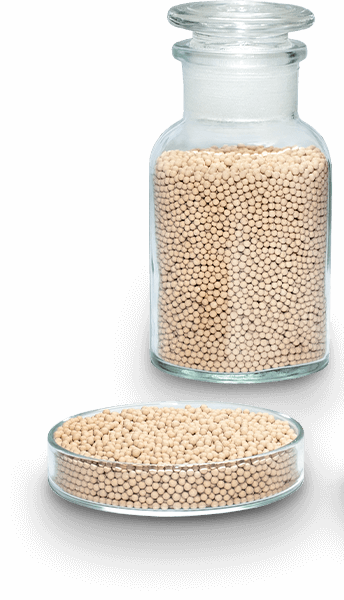
| 4A molecular sieve | 21% by weight | no | -100 °C |
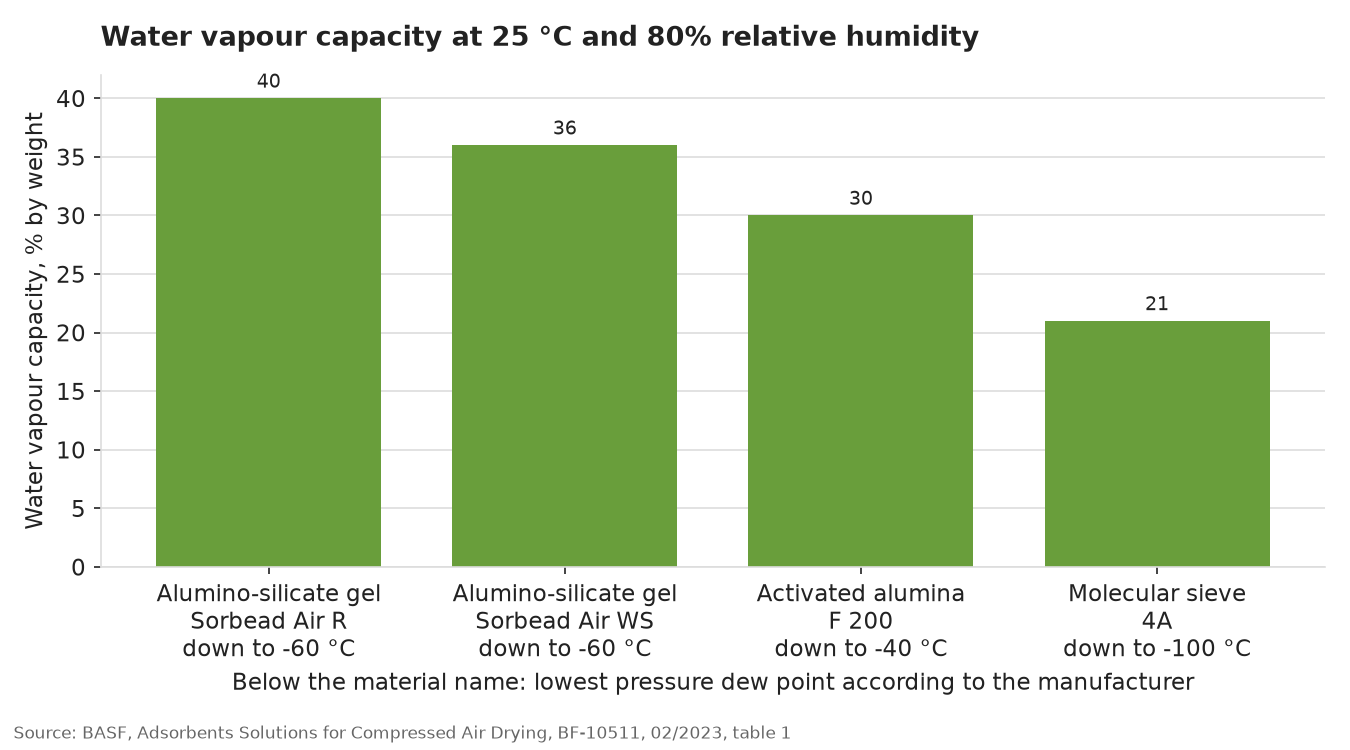
Fig. 1. Water vapour capacity of four desiccants at 25 °C and 80% relative humidity, and the lowest pressure dew point stated by the manufacturer. Data: BASF brochure BF-10511.
All values in the table come from the BASF brochure on desiccants for compressed air drying [6] and describe groups of materials. To select a specific product, use its current technical data sheet.
Sorbead Air is an alumino-silicate gel in the form of hard spherical beads, not ordinary silica gel. Its regeneration temperature, its service life and, for the WS grade, its resistance to liquid water must not be assumed for other silica gels, including the indicating silica gels used in desiccant breathers and in packaging.
The capacity at 80% relative humidity is only one point of the adsorption isotherm. At this humidity, the 4A sieve binds the least water of the four materials in the table, but according to the manufacturer’s data sheet it retains a high capacity even at a very low gas humidity [9]. This is why the sieve, and not the material with the highest capacity at 80% humidity, gives the lowest dew point. The difference between silica gel and molecular sieve at low and at high humidity is described in the article Silica gel or zeolite molecular sieve: what to choose.
Desiccant capacity and dew point
The material that binds the most water from humid air does not necessarily give the driest air at the dryer outlet. The dew point depends above all on how much water remains in the bed after regeneration and how strongly the desiccant holds water when the air is already almost dry. The dew point given in the data sheet of a material is therefore a value that can be reached under specific operating conditions of the dryer, not a fixed property of the material.
Bed regeneration in adsorption dryers
An adsorption dryer usually has two vessels with a desiccant bed that work alternately: in one vessel the bed dries the air, in the other it is regenerated. The capacity of a desiccant decreases with rising temperature and with falling partial pressure of water vapour, so water can be desorbed by heat or by a reduction in pressure. Regeneration consists in creating conditions that favour desorption and in removing the released water from the vessel. Depending on the dryer design, this is done by heating the bed, by reducing the pressure, by a flow of dry air, or by a combination of these methods.
In heat-regenerated dryers, the typical regeneration temperature according to the adsorbent manufacturer is about 120 to 150 °C for Sorbead Air alumino-silicate gel, 170 to 200 °C for activated alumina and above 200 °C for 4A molecular sieve [6]. The higher the regeneration temperature, the higher the energy consumption in each cycle and the longer the vessel must be cooled before it is put back into operation. In the same brochure, the manufacturer gives a bed service life of about 5 years for its gel and of 2 to 4 years for activated alumina. This is a statement of the manufacturer; the actual service life of the bed depends on the operating conditions of the dryer.
In a heatless (cold-regenerated) dryer, the bed is regenerated without heating by part of the dried air (purge air), expanded to atmospheric pressure. According to the BASF brochure [6], the vessels switch every few minutes, and during this time the bed takes up less than 1% of its weight. Regeneration uses 12 to 25% of the dried compressed air, depending on the operating pressure, which means high energy costs.
In a heatless dryer, the bed is not dried completely: each regeneration restores only as much capacity as is needed for a few minutes of operation until the next changeover of the vessels. The standard fill of such a dryer is activated alumina. Molecular sieve is used in it when the lowest dew point is required or when the air at the inlet is warm, above about 38 °C [11].
The dynamic capacity given in the literature always refers to a specific type of dryer and to specific cycle conditions. For example, the values in the BASF article [7] were determined for heat-regenerated dryers. Before the mass of the bed is selected, check for which dryer this capacity was determined, and do not transfer it to a dryer of another type.
Selection according to the dryer type
The dryer type largely determines which dew point can be reached and which materials can be used in the dryer. The table combines data from the materials of BASF, an adsorbent manufacturer [6] [8], and of Atlas Copco, a dryer manufacturer [10] [12].
| Dryer type | Regeneration | Pressure dew point according to the manufacturers | Desiccants used |
|---|---|---|---|
| heatless (cold-regenerated) | part of the dried air after expansion, without heating | -25 to -40 °C, versions down to -70 °C | activated alumina; 4A molecular sieve for dew points down to -70 °C |
| externally heat-regenerated, standard | blower air heated by a heater; for cooling, usually part of the compressed air | -25 to -40 °C, with 4A sieve down to -70 °C | alumino-silicate gel, activated alumina; 4A molecular sieve for dew points down to -70 °C |
| heat-regenerated purgeless (zero-purge) blower dryer, without compressed air consumption | desorption and cooling with ambient air supplied by a blower | -25 to -60 °C | alumino-silicate gel, usually with a guard layer resistant to liquid water on the inlet side |
| heat-regenerated with heat of compression | hot air from an oil-free compressor; the bed is regenerated under pressure | -15 to -40 °C, typically -20 °C without additional heating | a desiccant resistant to hot and humid regeneration air |
Water class 1, that is a pressure dew point of -70 °C or lower, can be reached in both heatless and heat-regenerated dryers if the bed contains 4A molecular sieve [12]. In a heat-regenerated dryer, the sieve requires a regeneration temperature above 200 °C, because only then does it release as much water as is needed for such a low dew point. The sieve is also used when the air fed to the dryer is pre-dried or has a low relative humidity.
In a heat-of-compression dryer, the bed is regenerated by hot air taken directly from the compressor, which contains a lot of moisture. For such dryers, the adsorbent manufacturer recommends an alumino-silicate gel resistant to liquid water and justifies this by its resistance to ageing in hot, humid gas and by its low regeneration temperature [6].
Most common mistakes when choosing a desiccant
Selection based on the equilibrium capacity from the data sheet. The value “40% at 80% relative humidity” describes the capacity of the material in humid air. It does not say how much water the material will hold when the air at the dryer outlet is already almost dry, or how much water will remain in the bed after regeneration. Materials are compared under the operating conditions of the dryer in which they are to be used.
Transferring capacities from heat-regenerated dryers to heatless dryers. Values of around 12 to 20% by weight given for heat-regenerated dryers [7] do not describe the operation of a heatless dryer, in which the bed takes up less than 1% of its weight when the vessels switch every few minutes. A bed mass calculated from such a capacity is many times too small, so the mass of the bed is taken from the documentation of the dryer manufacturer.
Molecular sieve in a heat-regenerated dryer at too low a temperature. The sieve must be regenerated at a temperature above 200 °C to release as much water as is needed for a very low pressure dew point. In a dryer designed for regeneration at 120 to 150 °C, the sieve will not be regenerated sufficiently, and the dryer will not reach the dew point for which the sieve was chosen. Where a pressure dew point of -40 °C is sufficient, replacing the existing desiccant with a sieve should only be considered after comparing the whole cycle: the dew point reached, the working capacity of the bed and the energy consumption.
A bed without protection against liquid water. Silica gel that is not resistant to liquid water, including Sorbead Air R, cracks on contact with it. If liquid water can reach the dryer, the bed is built of two layers: on the inlet side a gel resistant to liquid water, for example Sorbead Air WS, and behind it a standard gel that does the drying [6] [8]. The guard layer protects the bed against the effects of accidental water ingress, but it does not replace a water separator or a properly working condensate drain.
Dew point given without the measurement pressure. The same air has a different dew point at the operating pressure and after expansion to atmospheric pressure. In the range typical of adsorption dryers, the difference is from more than ten to about 20 °C, as in the example in the section on converting the dew point. The water class according to ISO 8573-1 is determined by the pressure dew point, that is the value at the operating pressure [1].
Frequently asked questions
Which desiccant is used in a heatless dryer?
The standard fill is activated alumina. 4A molecular sieve is used when a pressure dew point of -70 °C is required or when the air at the inlet is warmer than about 38 °C [11]. The type of desiccant, the grain size and the mass of the bed are specified by the dryer manufacturer in the documentation of the equipment.
Can silica gel reach a pressure dew point of -70 °C?
The manufacturer of Sorbead Air alumino-silicate gel states a pressure dew point down to -60 °C for it in heat-regenerated dryers [6] [7]. For water class 1, that is -70 °C and below, manufacturers indicate 4A molecular sieve, in both heatless and heat-regenerated dryers. For other silica gels, the dew point that can be reached must be checked in the technical data sheet of the product.
Can activated alumina in an existing dryer be replaced with silica gel or molecular sieve?
Sometimes, but not on the basis of the desiccant data sheet alone, because the new material must match the regeneration method for which the dryer was designed. Molecular sieve requires regeneration at a temperature above 200 °C, so in a dryer designed for activated alumina and regenerated at 170 to 200 °C it may not release enough water. Alumino-silicate gel is regenerated at a lower temperature, 120 to 150 °C, but its grades that are not resistant to liquid water require a guard layer on the inlet side. Before the desiccant is replaced, check the regeneration temperature, the method of cooling the bed, the cycle time and the required grain size in the dryer documentation or with the dryer manufacturer.
Sources
- ↑ ELIMFILTERS Engineering Diagrams: “ISO 8573-1 Compressed Air Purity Classes”, table of water content classes 1 to 6, elimfilters.com
- ↑ Atlas Copco: “Understanding ISO classes for compressed air quality”, purity classes for humidity and liquid water with examples of applications, atlascopco.com
- ↑ Engineers Edge: “Vapor Pressure of Ice Table”, vapour pressure over ice from 0 to -80 °C, engineersedge.com
- ↑ National Physical Laboratory: “Dew point and relative humidity”, Magnus formulae over water and over ice with their range of validity, frost point, enhancement factor, npl.co.uk
- ↑ Process Sensing Technologies (Michell): “How to calculate pressure dew points accurately”, dependence of the dew point on the total pressure, processsensing.com
- ↑ BASF: “Adsorbents Solutions for Compressed Air Drying”, BF-10511, 02/2023, table of desiccant properties, table of selection by dryer type, heatless and heat-of-compression dryers, basf.com (PDF)
- ↑ A. Vityuk (BASF): “Adsorbents for Heat Reactivated Compressed Air Dryers”, Compressed Air Best Practices, regeneration temperatures and dynamic capacities in heat-regenerated dryers, airbestpractices.com
- ↑ BASF: “Sorbead Air for Air Drying”, dew points by dryer type, compressed air consumption for cooling, Sorbead Air WS layer, basf.com
- ↑ BASF: “Product Datasheet BASF 4A Molecular Sieve”, BF-9393, 08/2012, water capacity, bulk density, regeneration methods, l-i.co.uk (PDF)
- ↑ Atlas Copco: “Improve compressed air quality with an adsorption dryer”, types of adsorption dryers, purge air consumption, pressure dew point of heat-of-compression dryers, atlascopco.com
- ↑ Compressed Air Best Practices: “Heatless Compressed Air Desiccant Dryer Calculation Principles”, Skarstrom principle, minimum purge air flow, bed mass per unit of flow, desiccant selection by dew point, airbestpractices.com
- ↑ Atlas Copco: CD+ heatless dryers in the version with a pressure dew point of -70 °C, product page, atlascopco.com (DE)
We will select a desiccant for your dryer
Send us the manufacturer and model of the dryer, the regeneration type, the operating pressure, the inlet air temperature, the required pressure dew point and the data of the current bed: material, grain size and layer arrangement. If you have the equipment documentation or cycle data, please attach them. We will indicate the materials that can be considered and confirm the quantity on the basis of the dryer documentation. If the description shows that the cause of the problem is filtration or condensate drainage rather than the bed, we will tell you so directly.